
Blog
6 Off-the-Beaten-Path Places to See a Different Benin
Ganvié and Abomey draw the crowds. Six other places in Benin — just as real, just as striking — remain largely undiscovered.
Ganvié, the Royal Palaces of Abomey, the Python Temple in Ouidah — these are, rightly, the names that come up first when planning a trip to Benin. But the more you explore the country, page after page, the more another map appears: one of places that many Beninese themselves don't yet know. Here are six of them — for those who have already ticked off the essentials, or who would rather start with these.
1. The Sacred Forest of Kpassè, Ouidah
A stone's throw from the Python Temple, in the very heart of Ouidah, a sacred patch of forest has resisted urbanisation for centuries. Legend has it that King Kpassè, founder of the Houéda kingdom, mysteriously vanished there before being reincarnated in an iroko tree at the heart of the forest. Today the site works as an open-air museum, with statues of the vodun pantheon — Legba, Sakpata, Gou — carved by local artists. Part of the forest remains reserved for initiates; the rest can be visited with a guide.
2. The Underground Village of Agongointo-Zoungoudo, near Bohicon
During roadworks between Abomey and Bohicon, a construction machine suddenly collapsed into the ground and revealed a vast network of underground shelters dug in the 18th century — ahwando, "war holes" in the Fon language, believed to have served as refuges during the conflicts of the Danxomé era. Fifty-six of the roughly 1,600 shelters recorded are now open to the public in an open-air museum built from local materials. The site is on UNESCO's Tentative List — a rare recognition for a place whose access remains a matter of local know-how (the simplest way: ask a zémidjan, a motorbike taxi, to take you to the Motel Fifatin, the only reliable landmark nearby).
3. The Black River of Adjarra
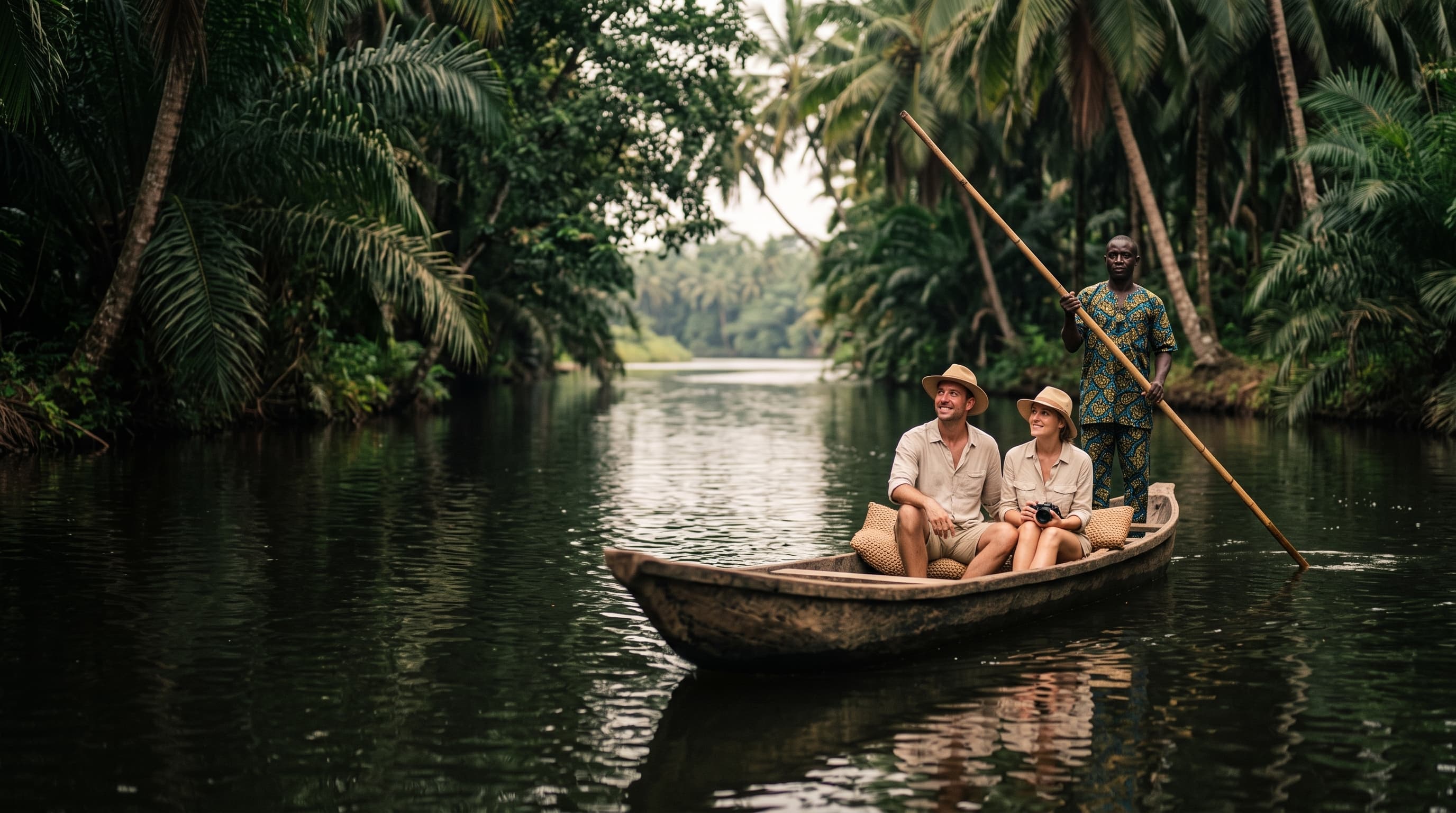
About thirty minutes from Porto-Novo, a waterway winds beneath a canopy of ferns and raffia palms, its waters stained almost black by the surrounding organic soils. You explore it by traditional pirogue, at the pace of the paddle, among crocodiles and birds. The Adjarra area, known for its handmade drums and pottery, is a natural complement to the visit — organised tours often include a tam-tam-making demonstration and a look at how sodabi, the local palm spirit, is distilled.
4. The Hills of Dassa-Zoumè
Forty-one granite hills form a natural amphitheatre here, in the Collines department. The site blends Yoruba royalty with international Catholic pilgrimage — every 15 August, thousands of the faithful gather around the Marian grotto of Arigbo. A landscape unlike any other in Benin, and one that remains largely outside the standard tourist circuits.
5. The Stilt Villages of the Aguégués
Ganvié draws the crowds; the Aguégués, a little further along the lake, remain off the radar. Life is organised entirely on the water, with far fewer visitors — an alternative for anyone after the same lake-village experience without the crowds.
6. The Dankoli Fetish, Savalou
A sacred vodun tree entirely covered in nails and offerings, its legend tied to King Agadja — one of the vodun sites most visited by curious international travellers, precisely because it concentrates in a single place all the symbolic weight of fetish worship.
Before you go: several of these sites are hard to reach without a local landmark, and some (Agongointo, the Forest of Kpassè) remain living places of worship where respecting local taboos — no red clothing inside a totem house, for instance — is part of the visit. For most of them, a local guide remains the best way to understand what you're looking at, not just to get there.
Find the practical details for each site in our attraction pages.
Ready to go?
Plan your trip to Benin
Verified stays, transport, activities, and agencies — everything you need to organize your trip.
Plan Your Trip