
Discover Benin → History
The Slave Route & Ouidah
A 4-kilometer path tracing one of the most painful chapters in human history, through the former slave port of Ouidah.
A 4-kilometer path tracing one of the most painful chapters in human history
In brief
For more than two centuries, the coastal town of Ouidah was one of the main ports of the transatlantic slave trade in West Africa. Today, the Slave Route — a 4-kilometer memorial path linking the town center to the ocean — retraces, step by step, the final journey taken by hundreds of thousands of people who were enslaved before their deportation. It's a site of global memory, and one of the most visited in Benin — one that calls for the respect and emotional availability it deserves.
Why Ouidah
Once a town of the Xwéda kingdom, Ouidah became a strategic trading point between West Africa and Europe as early as the 17th century. The Kingdom of Danxomé seized the town in 1727, under King Agadja, giving it direct access to the coast — and to trade with the European powers that had already established fortified trading posts there (French, English, and Portuguese forts, the latter of which still stands today).
For more than two centuries, until France abolished the slave trade in 1848, Ouidah became one of the main departure points for the transatlantic trade in the Gulf of Guinea. Estimates vary by source, but a figure of more than one million people deported from this single port is commonly cited.
The path of memory
The Slave Route begins at Place Chacha (or Place des Enchères, "Auction Square"), in the heart of Ouidah, where captives were sold to European traders. The memorial path, marked by statues and installations evoking the kings of Danxomé and the stages of the trade, includes several stations heavy with meaning, among them:
- The Tree of Forgetting — enslaved men were made to walk around it nine times, women seven times, in a ritual meant to make them "forget" their identity, family, and culture before embarkation.
- The Zomaï Memorial ("the stopover of return"), a place of reflection along the path.
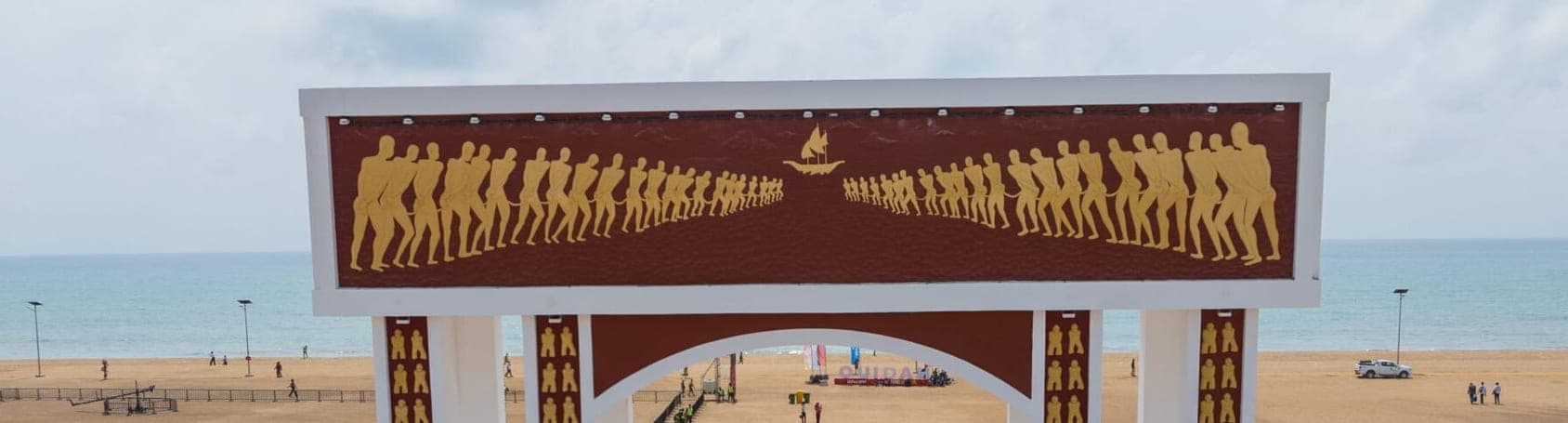
- The Door of No Return, erected in 1995 at UNESCO's initiative on the very beach from which canoes carried captives out to the slave ships anchored offshore. This monument, adorned with frescoes depicting departure and the receding African coastline, symbolically marks the end of the path — and the beginning of an exile with no return for generations of Africans deported to the Americas. Closed to the public from August 2020 to March 2025, it has since undergone a complete reconstruction: the arch was repositioned on the site's historical axis and raised to 17 meters, and a life-size replica of a slave ship was installed in a water feature right beside it. This rehabilitation is part of the "Ouidah Project," led by the ANPT, which aims to make the city Africa's flagship destination for memorial tourism.
A living place, not just a museum
What sets Ouidah apart is that this site of memory remains home to an ongoing spiritual and cultural life. It's here, every second Friday of January, that the most important celebrations of the National Vodun Day take place (see our dedicated page). The connection between the Slave Route and the Afro-descendant religions of the Americas — Haitian Vodou, Brazilian Candomblé, Cuban Santería — is no coincidence: the same routes of deportation carried, against all violence, the beliefs and spiritual practices of West Africa to the New World. Ouidah is today a place of pilgrimage for many Afro-descendants seeking to reconnect with this heritage.
How to visit this site properly
Visits are generally made with a local guide trained in the site's history — a practice worth prioritizing both for the depth of context it provides and out of respect for the place. Allow enough time to walk the full path, visit the adjoining museums, and take a moment of silence facing the ocean at the Door of No Return. This is a visit that calls for openness and attentiveness rather than a box to check on an itinerary.
Extend the visit
- The Slave Route — practical information for visiting the path
- The Door of No Return — the monument today, after its rehabilitation
- The Portuguese Fort of Ouidah (history museum)
- The Zinsou Foundation, for a dialogue between historical memory and contemporary African art
- Our page on Vodun, to understand the spiritual thread that runs through this place
Ready to go?
Plan your trip to Benin
Verified stays, transport, activities, and agencies — everything you need to organize your trip.
Plan Your Trip